Day 1460
What the Square Knew

It is 05:30 on Sunday morning in Kyiv and Russia has already launched at least 16 rockets at the city. CNN’s Clarissa Ward, who told Politico’s Dasha Burns this week that Ukrainians no longer feel superhuman — that they feel broken, exhausted, barely able to get out of bed — is somewhere in the city on assignment. If she can get to the Motherland monument in Park Slava before sunrise, the lighting over the Dnipro will be perfect. So will the drones. It would make rather better television than the soggy toast anniversary package filed on Friday and sourced entirely from Z’s own circle. The real story is elsewhere. It has been elsewhere for some time.
Two of the most significant works of long-form journalism published in the past two months — Adam Entous’s 12,500-word investigation in the New York Times and Shaun Walker’s 6,700-word account in the Guardian, produced by 19 journalists, drawing on over 400 interviews across 22 countries and naming 81 officials — arrive at the same quietly devastating conclusion: that Z knew Russia would invade, did nothing, and pretended otherwise.
Team USA does not emerge clean. The Entous piece — ten named sections, seventy-seven individuals, a cast large enough to populate a middling Russian novel — documents a parallel performance: aid described as flowing when it wasn’t, negotiations described as progressing when they weren’t, and a man who promised peace in twenty-four hours treated as a serious student of the problem.
Germany, too, earns its place. Walker includes what may be the most perfectly Teutonic detail of the saga: Bruno Kahl, head of the BND, flew into Kyiv on February 23rd, 2022, declined a seat in the midnight evacuation convoy because he had meetings the next morning, and had to be extracted in confusion by Polish intelligence when those meetings failed to materialise — because a war had begun. A man whose profession was to know things, in the one city where the only relevant fact was already known by everyone except him.
Then there was the shared assumption that Ukrainians would absorb the invasion and submit. Eighty-one named officials. Four hundred interviews. Centuries of combined experience in the dark arts of knowing things about people. Apparently not one serious reckoning with Ukrainians themselves.
The failure surfaced bluntly in a Senate Armed Services Committee hearing on May 10th, 2022, when Senator Angus King pressed Lieutenant General Scott Berrier, director of the Defense Intelligence Agency. Berrier insisted there had been no assessment that Ukrainians lacked the will to fight — only that their capacity was insufficient. King replied: if you assess that a country will be overrun in weeks, you are making a judgment about will. Berrier had no real answer. The failure, as both articles now make clear, was not technical. No satellite missed anything. No signal went unintercepted. The failure was human.
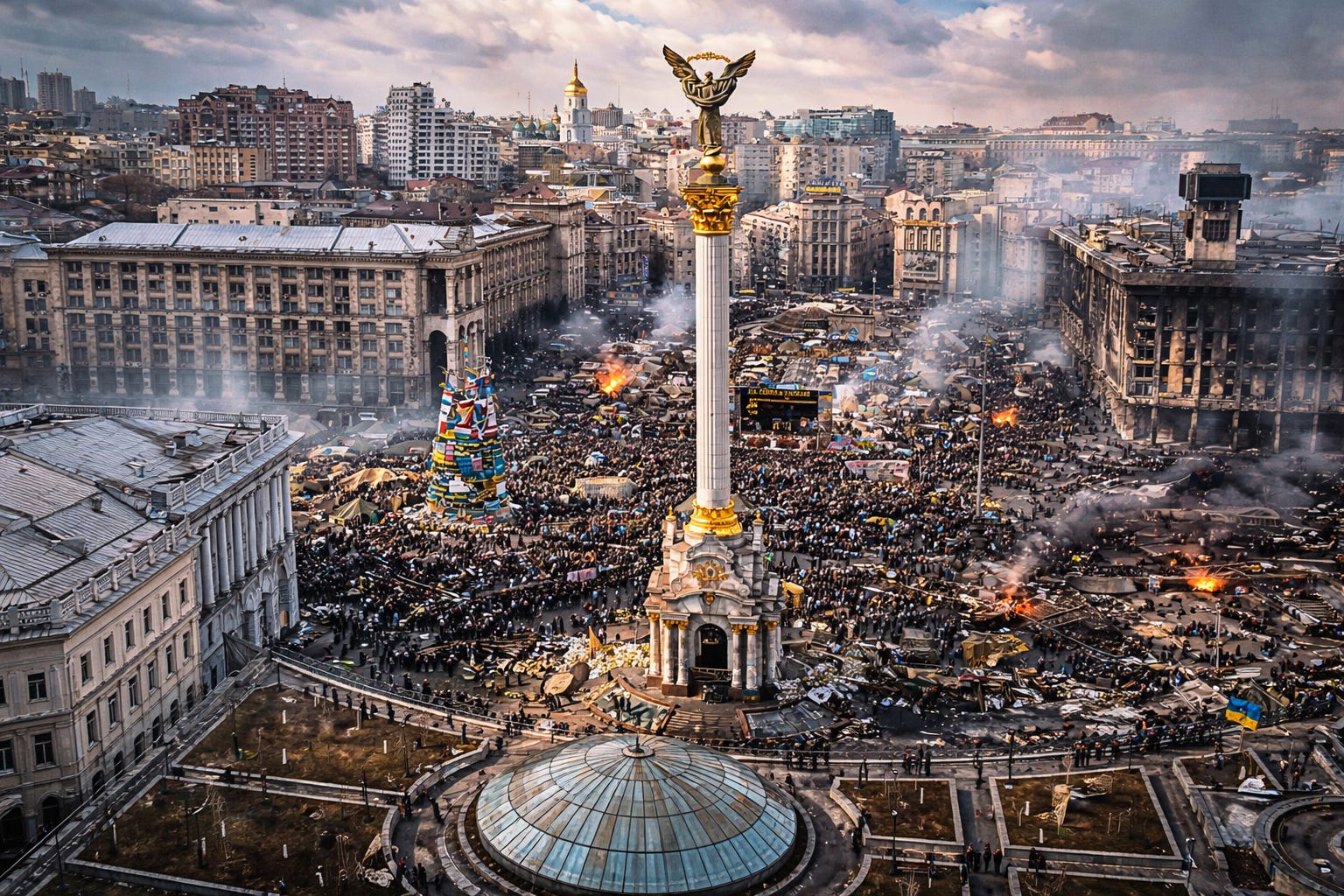
It was human because Western intelligence had spent three decades not truly studying Ukrainians — not their language, not their political memory, not the accumulated fury of a society repeatedly occupied, starved, Russified, and deceived. Anyone present on Independence Square in 2014, when ordinary Kyivans forced Yanukovych’s Berkut from the streets with their bodies and their rage, understood something fundamental had shifted. Western services were not in the kitchens and courtyards where the temperature of a people is taken. They were speaking to one another, mistaking consensus for insight, carousing at Tootsie Club.
Z was also absent. Weeks earlier he had co-hosted Russia-1’s New Year’s Eve special alongside Maxim Galkin, while Vladimir Solovyov — later a daily advocate of Ukraine’s destruction — applauded in the audience. He was professionally and financially embedded in Russia’s entertainment ecosystem as Ukrainians were dismantling it with their bodies. In March he said Russians and Ukrainians were one people. In May he was standing outside Red Square.
That context illuminates what followed: Russian-adjacent entertainer in 2014, insurgent president in 2019, unprepared wartime leader in 2022 — surrounded, in emergency, by people who saw chaos not only as crisis but as opportunity. Yermak’s office became the centre of gravity. Z held the podium; the back office ran the accounts.
A word about the millions who crossed westward with children and suitcases in 2022. That was not cowardice. It was parenthood. It must be kept distinct from the conduct of the elite class that remained. As refugees queued in the cold, defense contracts found cronies, fortifications went unbuilt, fallback lines existed on paper, conscription bit unevenly, and soldiers’ wages were insufficient. What should have been a war of attrition hardened into stalemate — not solely because of Russian resilience, but because of domestic corrosion.
And there was another Ukraine — the one neither article fully confronts. Alongside the heroism ran a quieter architecture of extraction. Yermak — who reassured Z that full-scale invasion was impossible and then became indispensable — presided over an office that functioned less as a centre of government than as a gravitational hub for patronage. Deputies investigated. Deputies charged. Energy-sector schemes recorded by NABU. An energy minister detained at the border in February 2026, attempting to leave the country hours after Z made jokes in Munich.
Biology supplies a metaphor: parabiosis. Connect an old circulatory system to a young one and the old blood does not rejuvenate — it toxifies. Three years of war fused a young administration to the oldest post-Soviet pathologies, and the exchange ran in one direction. The decisive moment came in February 2024, when Z dismissed General Valerii Zaluzhny — the one commander broadly trusted, the one willing to say the front had stabilized into stalemate and that political decisions now prolonged it. Zaluzhny was replaced. The stalemate remained.
Moscow estimated ten percent would fight. Washington planned for a government in exile. Berlin sent its intelligence chief to book a hotel room. Z, meanwhile, confused a country with a population, a population with a mood, and a mood with a forecast.