

Day 1505
Even a stopped clock
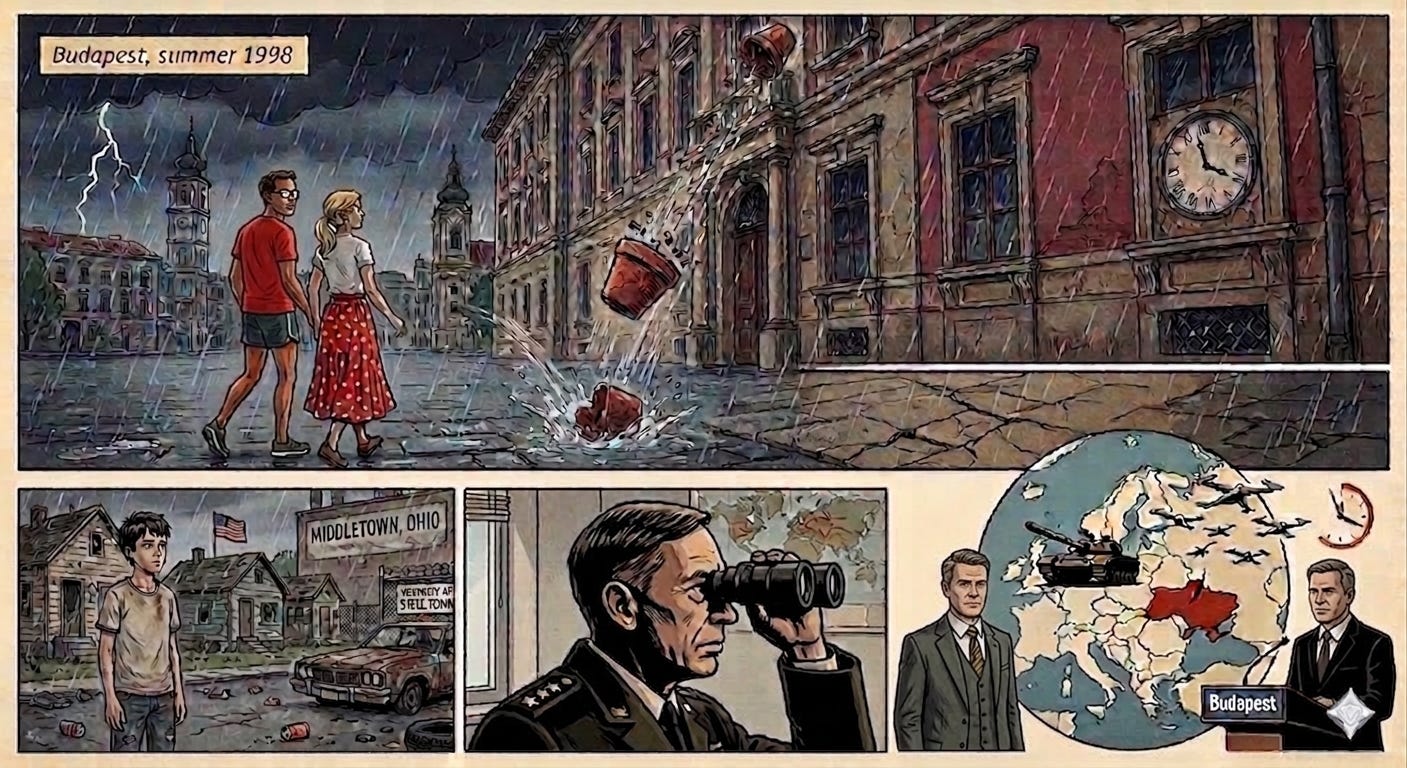
Let’s go back to yesterday’s flower pot1.
Budapest, summer 1998. A day so hot the city seems to stall — air thick enough to lean on, the Danube barely moving. By late afternoon the sky gives up pretending. Wind first, like a bailiff clearing the room. Then rain.
We had just come from dinner — avocado, tequila, the confidence that accompanies both — and were walking through the old city when, ten floors up, on the façade of one of those crumbling Habsburg buildings, a flower pot lets go.
It falls with authority. Not fast, exactly. Decisive. It misses us by what I will describe, generously, as inches.
The woman beside me that evening is the mother of our daughter. Our daughter was born in Kyiv. None of that was visible from the pavement that night. But there it is.
I was in vacationing that summer, as I often was in previous years, following a 4-year stint at bootstrapping ground-floorism. It was also, that time, a honeymoon. Around us, the prelude to something else was forming — decisions that would end in Vienna and Belgrade.
Elsewhere that summer, in Ohio, JD Vance was fourteen, surviving a difficult household. No one holds this against him. Childhood is not a choice. But it is worth noting that his relationship with eastern and central Europe — its wounds, its liberation and reconstruction — begins, and ends, with this week’s visit to campaign for Viktor Orbán.
David Petraeus was doing something else. In the Pentagon, at the elbow of the Chairman of the Joint Chiefs, working through Bosnia, Kosovo, the slow arithmetic of force in Europe. Not a tourist. A participant.
Three men, one summer. One in the rain under a falling flower pot. One in Ohio. One in the Pentagon.
I have, on these pages, been unkind to David Petraeus. I placed him in the usual Washington circuitry — advisory boards, contractor-adjacent policy circles, the permanent anticipation of the next war. Later, in the reconstruction salons: London, conference rooms, presentations about Ukraine’s future while its present continued to burn.
The description is accurate. It is also incomplete.
He has now been to Ukraine ten times since the invasion. Last week again: frontlines, drones, manufacturers. What he says on return is simple. Drone warfare is not an addition to modern war. It is modern war. The United States is not built for it.
“Innovativeness,” he noted recently, “is not giving 50 drones to an armored battalion. It is replacing the armored battalion.”
A retired four-star general, former CIA director, and partner at KKR — a firm shaped by Henry Kravis and George Roberts, and now circling European infrastructure and Ukraine-adjacent capital — suggesting the obsolescence of the systems that sustained that world. One notes the moment.
What he describes is not hardware but integration: surveillance, targeting, strike — one system. Ukraine’s Delta platform renders the battlefield as a continuous surface. He recounts watching a soldier tracked by successive drones, then struck. Observation is now terminal.
Ukraine will produce millions of drones this year; the United States, a fraction. Ukraine updates software in weeks; NATO doctrine moves in years. No coherent U.S. doctrine for autonomous formations. Promises delivered in the hundreds.
By 2022 the break was already visible. This is not an evolution of twentieth-century war. It is a replacement.
It is now being said aloud in rooms that matter, by people formed in the old system. That is not nothing.
Which brings us back to Budapest.
This week JD Vance arrived there to campaign for Viktor Orbán. He spoke about energy, civilisation, Brussels. What he did not speak about — what did not appear to interest him — is the transformation of war now underway on the same continent.
For him, Ukraine is a negotiation. Possibly a nuisance. Possibly, as he suggested, a meddling presence in Central European democracy.
The country rewriting the terms of modern conflict becomes, in this telling, an irritant to be managed.
The Budapest of 1998 understood something about direction. You could hear it in conversation, see it in the scaffolding — literal and otherwise. The work was unfinished, but it was work.
That sense is gone. Not because history reversed, but because it became easier to stop asking what it required.
Petraeus, for all the company he keeps, has at least been looking at the war. He has stood close enough to see what it is.
Vance flew in to talk about something else.
The flower pot missed. We looked up, stood in the rain a moment, and moved on. Some people, given time, pay attention to what nearly happened. Others arrive later and speak as if it didn’t.