

Day 1507
Green eggs and ham
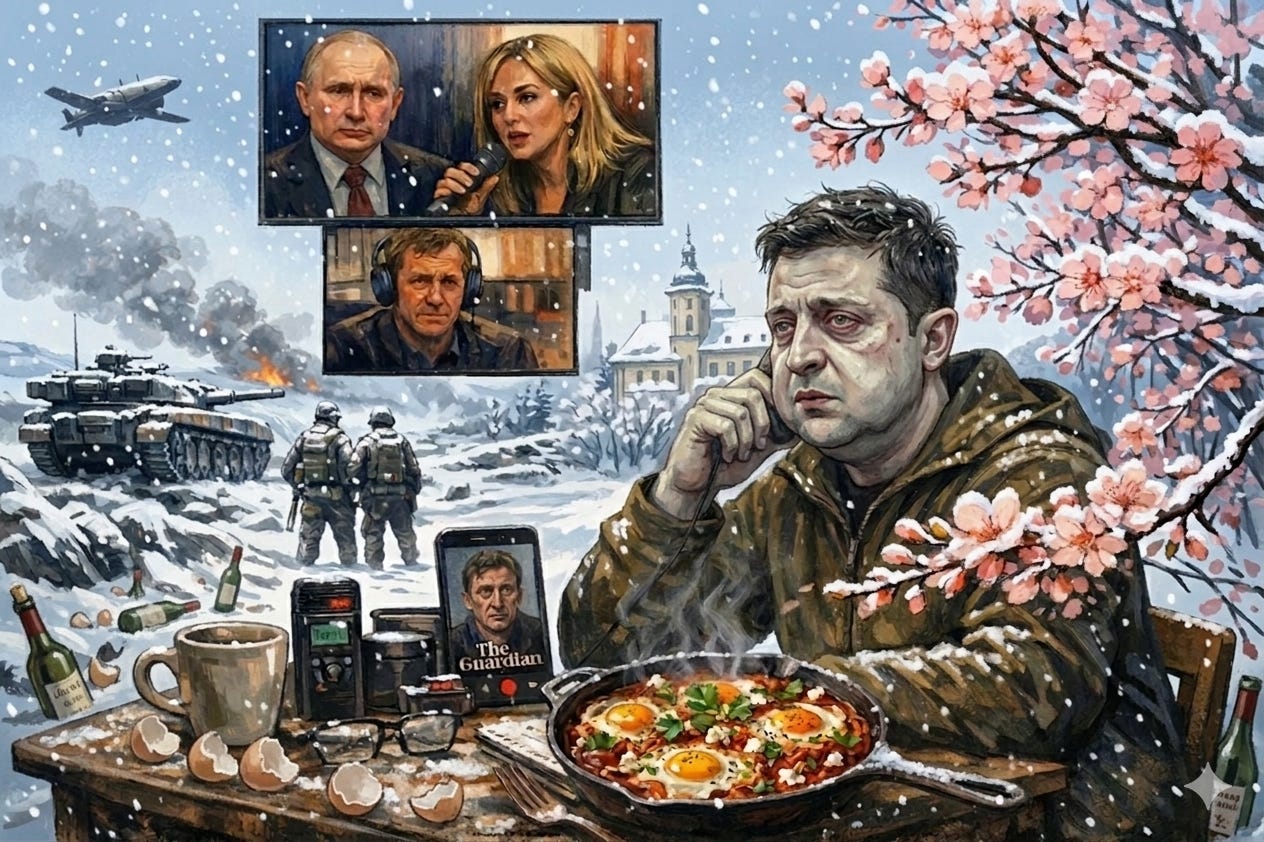
Z gave three performances this week — one to Alastair Campbell on The Rest Is Politics, one to RAI’s GR Radio, and one in Uzhhorod, where the cherry trees were already in bloom and, miraculously, someone had not yet taken a selfie. This is how wars are fought now — one eye on the front, one eye on the flowering branch.
In Zakarpattia he spoke of many things, as men in his position must. About multiple citizenship — five countries first, then others, the way you test a bridge before trusting it with a truck. The journalist from Uzhhorod nodded, satisfied with something that wasn’t quite an answer but had been carefully carved into the shape of one. About JD Vance’s “piece of territory” remark, Z explained, with the patience of a man long resigned to repetition, that a piece of territory is not the same as a piece of bread. About Pokrovsk: the enemy wants it by the end of April; he does not have the strength; the situation is very difficult but stable. This is how mountain people describe an avalanche that has not yet reached the village. The sakura was still blooming when he left.
The RAI interview is the most revealing of the three, precisely because it is so monumentally boring. Ready to meet Vladimir Putin — not in Moscow, not in Kyiv, somewhere in the Middle East or Europe or America or anywhere — the kind of statement that sounds like news and contains absolutely nothing. The Donbas argument, by now a set piece, is delivered again with the same fortification timelines, the same Kharkiv threat, the same “societal fracture” warning. Giorgia Meloni is “a strong leader.” Donald Trump thinks he’s honest with him. The €90 billion must be unblocked. One reads it waiting for a verb that has not yet been used.
Then there is the question of what to do with material that genuinely isn’t boring. Z’s claim that Russian military satellites photographed U.S. bases and Gulf energy infrastructure and passed the intelligence to Tehran is, if true, significant. He said it in the Campbell interview. Luke Harding at The Guardian duly ran it as a story, attributed to a podcast, under the byline of a journalist who functions, with some regularity, as Z’s stenographer. The story is real. The sourcing — a podcast conversation — tells you something about the current condition of the information ecosystem around this war.
It also lands at a moment when the Russia–Iran–Ukraine triangle has become impossible to ignore: as Day 1450 noted back in February — the very day Benjamin Netanyahu was in the White House Situation Room pitching Donald Trump on Iran — Russia was simultaneously launching one of its largest barrages yet on Ukraine, with Shahed drones coordinated from multiple Russian sites and Crimea. The overlap between Moscow’s war in Europe and its partnership with Tehran is not a podcast talking point. It is the architecture of the problem. The White House was being briefed on Iran while the evidence of Russian-Iranian coordination sat, apparently unread, in whatever inbox Z had sent it to.
The Campbell conversation itself has texture, though much of that is Campbell’s doing. Z’s English, once serviceable, is now genuinely difficult in places — as if the language itself has begun to tire. And yet the charge of circular reasoning undersells what is, at moments, sharp analysis. His three-part test for whether Putin wants peace — a trilateral leaders’ summit, American troops on the contact line, the absurdity of a man with seventeen million square kilometres demanding six thousand more — is structured and, probably, correct. His reading of Putin’s real objective as time, not territory, is more sophisticated than much Western commentary, and certainly more so than the credulous stenography currently passing for analysis at certain distinguished mastheads.
The problem is not Z’s thinking. It is that Campbell is too much the admirer and too little the interrogator — ending by dreaming aloud about Ukraine, Britain, and Canada joining the EU on the same day. That is not an interview; it is a toast delivered before the first course. Meanwhile his mother calls twenty times before he picks up. One understands the impulse.
In other news, Kyiv has woken up to snow, because April, like a minor official, refuses to follow instructions. The woman currently impersonating KonMari has returned on vaca with 34 tulips — a number that suggests either optimism or a lack of planning — and is eating shakshouka for breakfast, as if the Mediterranean might yet be persuaded to annex the weather.
Electricity outages have resumed, keeping everyone alert in the old-fashioned way, and Russia and Ukraine have tentatively agreed to a ceasefire for Easter Sunday — which is to say, they have agreed to the idea of agreeing, for a day.