

Day 1526
The Birthday in the Mountains
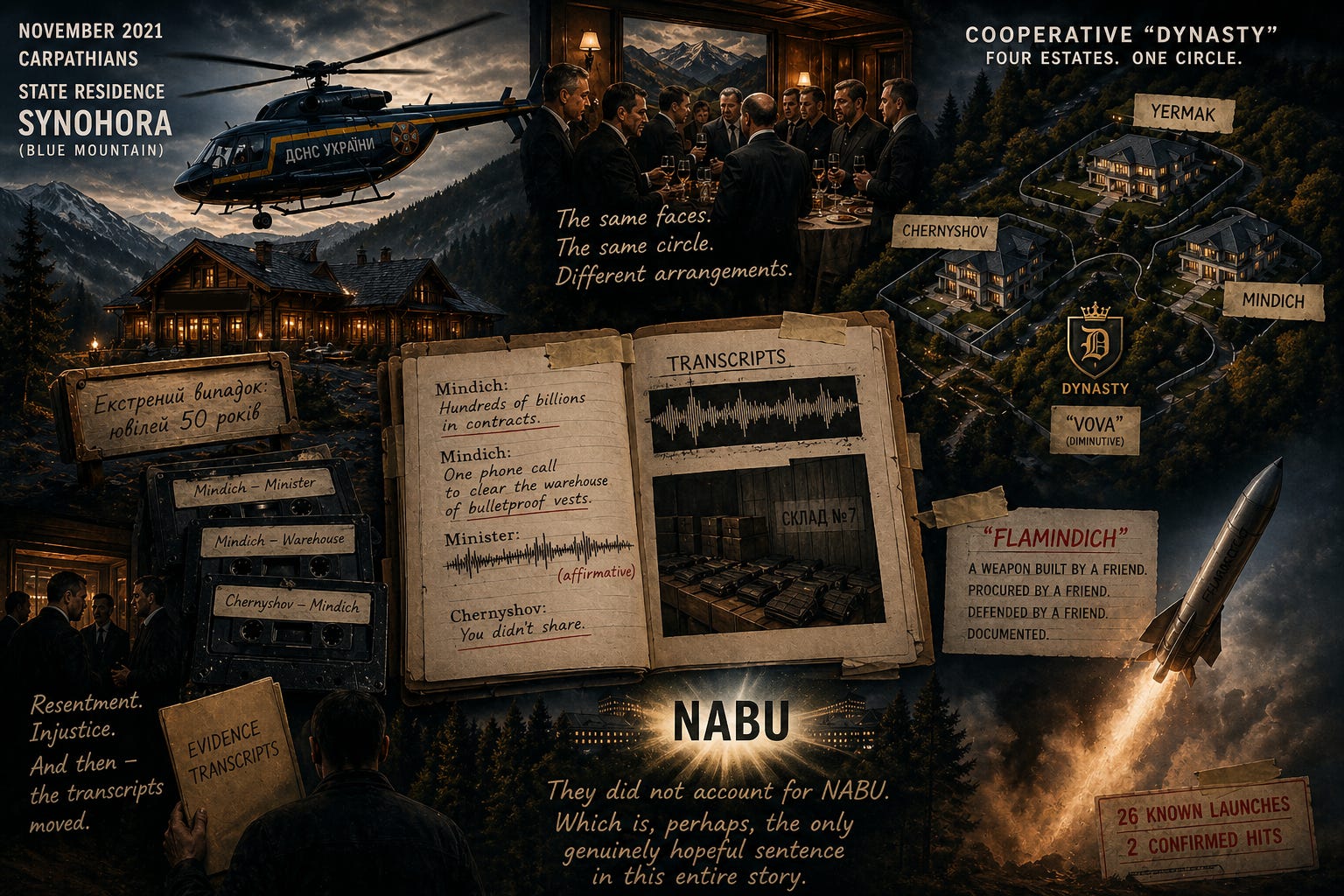
There is a particular kind of friendship that does not need to be explained, because it explains everything around it. It is the kind that secures a helicopter from a state emergency service for a private occasion, because an emergency, after all, had arisen: a man was turning fifty, and the mountains were far away.
This happened in November 2021, in the Carpathians, at a state residence called Synohora — Blue Mountain — which is a beautiful name for a place where beautiful arrangements are made1. The guests arrived. Among them, the same faces that would later appear, like recurring characters in a novel whose author denies writing it, across defense contracts, land schemes, and recordings that were never meant to be heard.
Three years later, the same circle — older, richer, considerably more exposed — was still meeting. Still building. Four estates in a cooperative called Dynasty, which is a name that requires no translation. One for Yermak. One for Chernyshov. One for Mindich. One, according to those who listened, for a man referred to simply as “Vova,” which is a diminutive, and diminutives in the Ukrainian tradition are reserved for intimacy.
I want to be precise about what I am and am not arguing here. I am not presenting a verdict. I am not constructing a prosecution. At a certain point, the question stops being whether any single fragment proves direct involvement and becomes whether the total pattern still allows for meaningful distance. When the same circle of long-time associates appears across state contracts, private ventures, and informal coordination — and when decisions affecting those flows consistently align with their interests — the space for plausible non-awareness narrows on its own. No single element settles the matter. But taken together, they make the idea of sustained detachment increasingly difficult to maintain. That is all I am saying. That, it turns out, is quite enough. (And I forgot to mention that ex-CIA chief/US Secretary of State Mike Pompeo joined the Advisory Board of Fire Point in November 2025, making this tragic drama even more idiotic.)
The transcripts arrived the way all important things eventually arrive in such stories: not through heroism, but through resentment. The investigators had distributed their evidence to the accused, as the law requires. Some of the accused were in detention. Others were in Israel, or the Canary Islands, or conducting meetings about foreign investment. Those who remained on the inside looked at those who remained on the outside, and felt the particular injustice that only the guilty can feel toward one another. And so the transcripts moved, from pocket to pocket, until they reached the journalists, who performed the unglamorous but necessary function of telling the public what it had already, in some sense, suspected.
What the tapes revealed, beyond the specific sums and favors, was a grammar. Mindich pressing the Defense Minister for hundreds of billions in contracts. Mindich asking for “one phone call” to clear a warehouse of bulletproof vests. The minister responding — that soft, affirmative sound that in Ukrainian carries the full weight of yes without the inconvenience of commitment. Chernyshov scolded not for corruption, which apparently required no comment, but for the graver sin of not sharing.
And at the end of all this: a missile. “Flamindich,” someone called it, with the specific cruelty of an accurate joke. A weapon built by a friend, procured by a friend, defended by a friend — and documented, by those who track such things, at two confirmed hits from twenty-six known launches.
There is an old understanding, common to all mountainous peoples, that a man who builds his house on a slope must be very certain of his foundations. The birthday guests built on friendship, on proximity, on the reasonable assumption that the institutions below them would remain, as institutions often do, politely inert.
They, including Mike, did not account for disclosure2.
Which is, perhaps, the only genuinely hopeful sentence in this entire story.
Autumnal canabilism. Pants on fire (November 25, 2021)
Statement by the Public Anti-Corruption Council at the Ministry of Defence of Ukraine Regarding the “Midas” Case
❗️ In connection with the fact that society has received unverified but significant evidence of ties between former Minister of Defence of Ukraine Rustem Umerov, sanctioned businessman Tymur Mindich, and the company “Fire Point,” the Public Anti-Corruption Council at the Ministry of Defence of Ukraine announces the following:
Based on materials held by anti-corruption authorities, the former Minister of Defence is believed to consider Tymur Mindich the de facto owner of “Fire Point.” All available data unequivocally indicates that Tymur Mindich is either one of the company’s beneficiaries or its sole true beneficiary.
Once this is confirmed legally — for example, by a court ruling — “Fire Point” will lose all ability to supply its products to Ukraine’s Defence Forces, given that Tymur Mindich is listed under sanctions. It is already evident that “Fire Point” provided deliberately false information regarding its beneficiaries and should consequently be fined and designated as a high-risk supplier.
🔺 We are therefore faced with a complex, multi-layered problem. De jure, the sanctioned businessman still has no formal connection to the company in question and could theoretically remain in this legal limbo for years while court proceedings and appeals drag on. De facto, the entire public has become convinced of the ties between Mindich and “Fire Point” — a perception that will become firmly embedded in the minds of both Ukrainians and international partners alike.
The state must now choose the least damaging strategy for Ukraine’s Defence Forces, which are actively using “Fire Point” products. At the same time, while fulfilling all legal requirements, the moral dimension of this matter remains of paramount importance. The country’s leadership is obligated to completely distance itself from past and present friendly relations with individuals who have exploited their positions, posts, and connections for personal enrichment.
☑ We interpret the actions of Rustem Umerov as bearing the hallmarks of abuse of power (Article 364 of the Criminal Code of Ukraine); and, with regard to his promotion of Mindich’s interests in the cases involving the “Israeli body armour” and “Fire Point” — disclosure of state secrets by a person to whom they were entrusted or became known in the course of official duties (Article 328 of the Criminal Code of Ukraine).
☑ We interpret the actions of Tymur Mindich as bearing the hallmarks of abuse of influence (Article 369-2 of the Criminal Code of Ukraine); and incitement to misappropriation of funds (Article 27, Part 4; Article 210 of the Criminal Code of Ukraine).
In light of the above, the Public Anti-Corruption Council at the Ministry of Defence calls for the following:
📌 The immediate removal of Rustem Umerov from his position as Secretary of the National Security and Defence Council of Ukraine.
📌 The President of Ukraine, in his capacity as Chairman of the NSDC, to initiate a process of selective (partial) nationalisation of “Fire Point” from its Ukrainian resident owners — which would allow, subject to certain conditions, for the uninterrupted supply of products to the front to continue, without enriching those implicated in corrupt abuses.
📌 The Ministry of Defence of Ukraine to establish a working group comprising representatives of the General Staff of the Armed Forces of Ukraine, the branches and services that use “Fire Point” products, as well as anti-corruption and investigative bodies — with a view to conducting a comprehensive audit of the company’s contracts and pricing, and to minimising the harmful consequences for Ukraine’s Defence Forces.
The Public Anti-Corruption Council at the Ministry of Defence stands ready to participate in the work of such a group in order to resolve the matter as swiftly as possible.