

Day 1528
The shortcut state
This morning I had to jump a wall to get into Kyiv’s Hryshko Botanical Garden.
Normally, the gates open at five. Around seven-thirty, guards begin charging admission—one hundred hryvnias, or thereabouts. It is an orderly arrangement: first nature, then bureaucracy.
This morning the gates were locked.
No explanation was offered, which gave the situation a familiar administrative elegance. A few runners and people with dogs stood outside pretending to deliberate. I climbed over the wall.
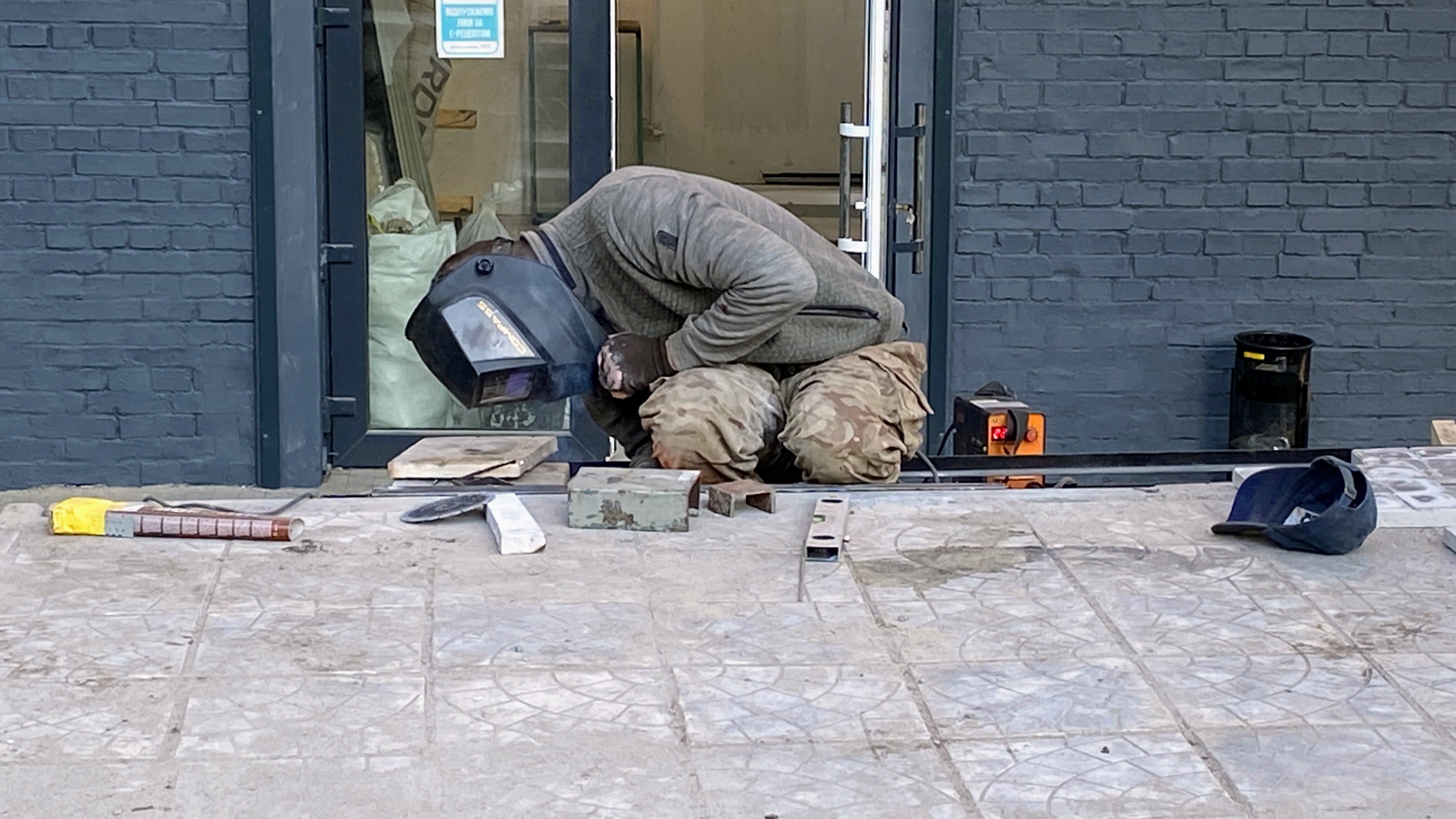
On my walk home, I passed a man welding an iron staircase outside an apartment building. He wore a strange helmet to keep sparks from reaching his eyes. It looked ridiculous. It also worked.
States develop similar helmets.


Somewhere in your body is a cell as long as you are tall1.
One end begins near your toe. The other reaches the base of your skull. A single neuron carries signals across that entire distance without relay stations, bureaucratic handoffs, or institutional review. It exists because speed matters more than elegance. If your nervous system required committee meetings between your foot and your brain, you would fall down every staircase you encountered.
Power often evolves the same way.
Formal institutions are slow. Ministries deliberate. Parliaments vote. Procurement systems generate paperwork. Regulators ask questions. In stable democracies, this friction is called accountability.
In unstable systems—especially wartime systems—that friction begins to look like an obstacle.
And so governments evolve informal neural pathways: private calls, trusted intermediaries, personal friendships, off-book meetings, conversations conducted in apartments and offices after midnight. These pathways are faster than formal institutions because they bypass them entirely.
Ukraine did not invent this phenomenon. Every state has versions of it.
What makes Ukraine unusual is that somebody recorded the signals moving through the nervous system.
And now the public can hear them.
Transcripts of conversations released over the past week—captured across 2025 and distributed in fragments throughout 2026—do not reveal a simple corruption scandal. Corruption is too primitive a word for what appears to be happening.
What they reveal is an operating system.
The recordings capture fragments:
Tymur Mindich telling Defense Minister Rustem Umerov that “our factory will stop” unless hundreds of billions begin flowing by the seventeenth.
Mindich asking for “one phone call” to force acceptance of bulletproof vests sitting in a warehouse.
Oleksandr Tsukerman and Vasyl Veselyi sitting in an apartment selecting the supervisory board of Sense Bank while calling candidates to verify loyalty.
The Ukrainian cabinet approving nearly that exact list forty days later.
Luxury estates being built through a cooperative called Dynasty for Mindich, Andriy Yermak, Oleksiy Chernyshov, and someone referred to simply as “Vova.”
Three conversations.
Three sectors.
Defense procurement.
State banking.
Political appointments.
One invisible network.
The most revealing detail is not the money.
It is the language.
These men conduct official state business in Ukrainian.
They conduct actual power in Russian.
This matters less as a nationalist observation than as a sociological one. Language reveals assumptions about intimacy. About belonging. About who is inside the room and who is not.
The Dynasty cooperative tells the same story in concrete form.
People do not build wartime palaces by accident.
They build them because they assume continuity.
They assume protection.
They assume the future belongs to them.
A mansion is simply political confidence made visible in stone.
And while this parallel state was constructing houses, much of the Western press remained hypnotized by the official performance of wartime heroism.
Timothy Snyder wrote moral epics.
Sean Penn filmed documentaries.
David Remnick polished narratives.
The New York Times, The Washington Post, and Financial Times largely repeated the visible story while Ukrainian investigative journalists did the dangerous work of following the hidden one.
Perhaps they did not see it.
Perhaps they preferred not to.
The distinction matters less than people think.
The result was the same: Western audiences were given a heroic screenplay while the real script was being written elsewhere.
The recordings reveal how this hidden circuitry functions.
Formal authority exists.
But informal authority dominates.
A businessman appears more powerful than ministers.
Ministers seek approval from men with no formal title.
Appointments are determined before formal competitions begin.
Contracts are distributed before tenders conclude.
Board seats are assigned before committees meet.
The visible state becomes little more than a ceremonial reenactment of decisions already made in private.
This is not the abolition of institutions.
It is worse.
It is their theatrical preservation.
Institutions continue existing precisely so they can legitimize outcomes generated elsewhere.
Like muscles receiving instructions from a hidden nervous system, they move without understanding why they are moving.
There is also something darkly comic in how these systems fail.
Not through morality.
Not through revolution.
Not through sudden democratic awakening.
They fail because insiders begin hating one another.
Investigators distributed evidence to suspects, as procedure required.
Some suspects were in detention.
Others were abroad.
Others remained protected.
Those still vulnerable developed the ancient resentment of unequal criminals.
And so the transcripts began moving from hand to hand until they reached journalists.
History often arrives not through idealism, but through wounded vanity.
Everyone in these recordings believes they are saving Ukraine.
Mindich speaks about weapons production.
Z speaks about defending civilization.
Umerov speaks about wartime necessity.
Everyone believes speed justifies bypassing process.
Everyone believes loyalty is more efficient than institutions.
Everyone believes emergency suspends ordinary rules.
And perhaps, in the short term, they are correct.
That is what makes systems like this so durable.
The shortcut works.
Until it becomes the road.
The recordings do not show cartoon villains twirling mustaches over stolen cash.
They show intelligent people making rational decisions inside a structure that rewards speed, secrecy, and loyalty over competence, law, and institutional trust.
And that is far more dangerous.
Because corruption can be prosecuted.
But rational systems that slowly consume the institutions meant to restrain them?
Those can survive for years.
Sometimes until the war ends.
Sometimes long after.
By then, the people who needed institutions most—those without access to informal networks—have already paid the price.
These are pseudounipolar neurons that have their cell bodies located in the Dorsal Root Ganglia (DRG) near the spinal cord.
hi, critt! ouch! the L5 DRG would be involved in that pathology. degenerative disc disease at L5 can compress or irritate the L5 nerve root as it exits, affecting the L5 DRG and causing pain/numbness in the L5 distribution (lower leg, foot). i was amazed to learn how long sensory nerve cells are: the end of the axon (the long projection of the neuron) terminates near your toe or fingertip, and the other end reaches all the way to the base of your skull (the medulla in your brain stem)
I used Claude to explore DRG. Helpful response. I have L5 degenerative cervical disease. Thanks.