

Day 1478
Cards. Chess. Clowns. But Never Wrestling.
A digression on open cards, closed minds, and the peculiar confidence of people in rooms.
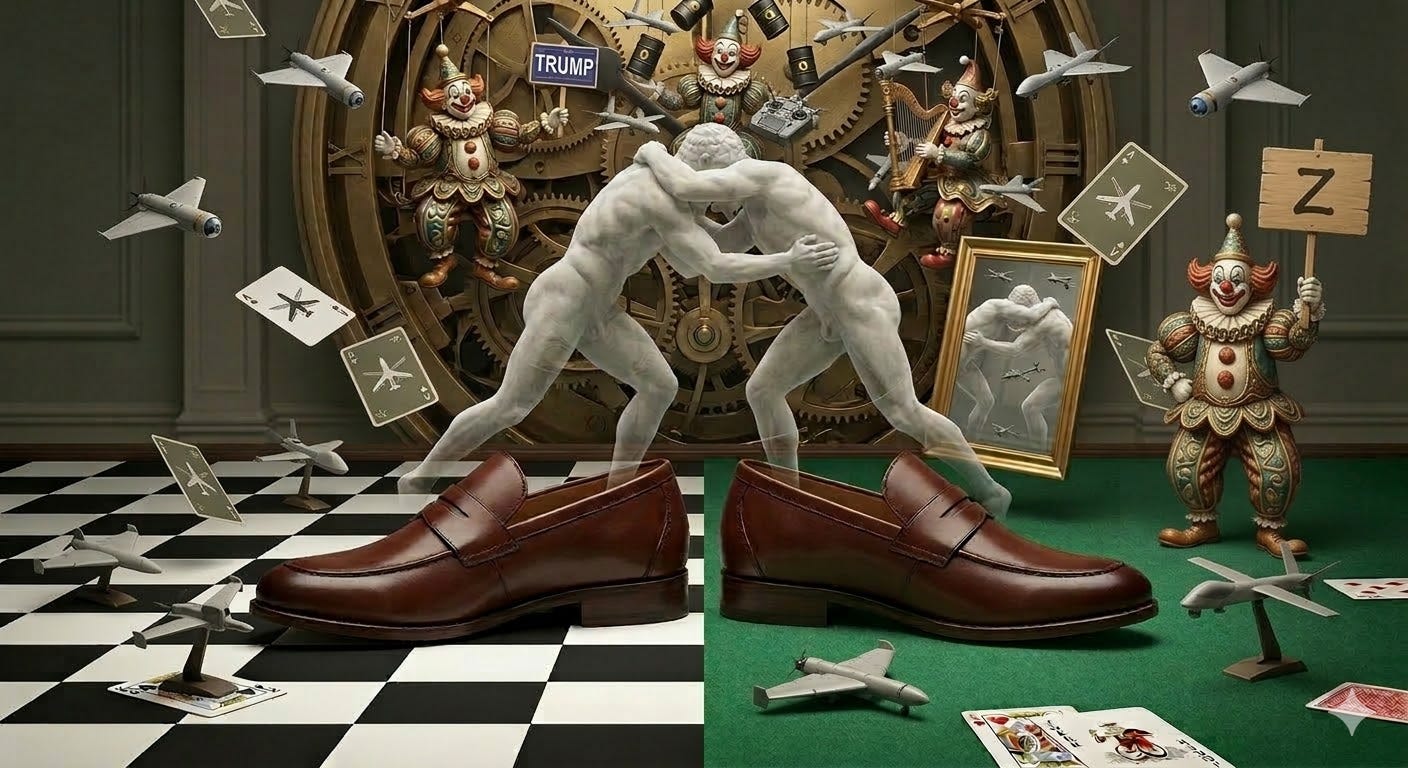
Yesterday I wrote about a man who looks into a mirror and sees, reflected back, the precise image of himself he had always hoped to find. The mirror, in this case, happened to be a camera1.
Today I want to write about another kind of mirror — the one that appears in rooms with mild hallucinogens and people of, as they say, unlimited capabilities, where everyone agrees so completely that the agreement itself becomes the most frightening thing in the room.
These rooms are full of metaphors. Cards are common. Drones buzz around oil barrels.
What almost never appears is wrestling.
I was told about such a gathering recently. The topic was the war in the Middle East. The consensus, reached with what my informant described as paradoxical and alarming unanimity, was this: Trump does not want a long war, therefore the war will end quickly. Two weeks, perhaps. Two months at the outside. Probably two weeks.
What struck me was not the conclusion but the reasoning. Everyone in the room had decided that Trump holds the situation like a deck of cards — that he can play them or withhold them at will, and that the game ends when he chooses to end it. The only debate concerned what he would settle for when he laid down his hand: an actual deal, or what my informant beautifully called “self-declaration of victory” — the art of pointing at rubble and announcing that the rubble was the plan all along.
Cards are useful instruments — in card games.
Over a lifetime of watching powerful men make confident predictions, I have noticed that the metaphor most often invoked in these rooms is always the one that flatters the man holding it.
There is, it seems to me, a better metaphor. It has been hiding in plain sight in the Oval Office.
The president, it was reported last week, has developed a habit of gifting close advisers pairs of his favourite loafers — a brown Florsheim, $145, paid for from his own pocket2. The ritual proceeds as follows: the president guesses the recipient’s shoe size out loud, in front of them. A week later, a brown box arrives. Sometimes the president has signed it. The recipient wears the shoes. Everyone, as one White House official put it, is afraid not to.
The Vice President wears them. The Secretary of State wears them. The Secretary of the Treasury, Commerce, Energy, the Special Envoy to the Middle East — all of them in matching loafers, in Davos, discussing the fate of nations.
A photograph of Secretary Rubio has been circulating. In it, his heel floats visibly above the back of the shoe. The president guessed wrong. The shoes are being worn anyway.
This is not mockery. The loafers are decent shoes. The generosity appears genuine.
But the ritual contains, in miniature, the logic of the moment: the strong man names the size, the box arrives, and the question of whether it fits is not one the recipient is in a position to raise.
This works well enough when the recipient is the Secretary of State. It works less well when the recipient is Iran, which did not apply for the position, has not accepted the box, and has been forming its own views about shoe sizes since 1979.
Z has solved the costume problem differently. Since the early days of the invasion he has worn, almost without variation, black tactical clothing — the costume of a man who has decided what the story is and intends to remain inside it. It is a clever solution. The clothing makes the argument so the man does not have to.
Interviewers arrive — our vlogger among them, air-raid siren on cue — and find themselves already inside a frame Z has built. The clothing says: this is a war, I am a soldier, you are a visitor. Most interviewers accept the premise.
Trump’s people wear whatever shoes they are given. Z wears the same thing every day. Both are costumes. Both make claims about who controls the story. The difference is that Z chose his own.
The deeper problem is that everyone is still speaking inside Trump’s metaphor.
Trump once declared that Z had no cards to play against Russia. It was a bully’s metaphor: the strong man naming the game, setting the table, deciding what counts as a hand. Z eventually adopted it himself. Analysts adopted it as well, because once a metaphor enters circulation the mind reaches for it automatically.
But what is happening in the Gulf is not poker.
It is wrestling.
More precisely: Greco-Roman wrestling.
The version where you may not attack the legs. Only the upper body. Only the clinch. Points accumulate slowly — throws, exposures, turns. A match ends either by pin or by technical superiority: an eight-point lead and the referee stops the contest immediately.
Between serious wrestlers the pin is rare. What is common is the grind — the patience of someone who knows the clock runs when the clock runs.
There is no bluffing in Greco-Roman wrestling. Only who lets go first.
Which is why the men in that room were also wrong about the clock.
A Greco-Roman match runs two periods of three minutes each. The analysts assumed the war would follow a similar format: short periods, predictable ending.
But the Iranians never agreed to the format.
They have not signed the scorecard. They are not entirely sure they received the memo about the three-minute periods. Iran also happens to be one of the great wrestling nations on earth — Olympic champions, a sport woven into national identity.
If you are going to set a wrestling clock against Iran, it is worth asking whether your opponent has done this before.
The Americans are not winning by eight points. The match has not ended early. The periods are still running.
The Iranians — and beside them, quietly, the Russians and Chinese — can see Trump’s hand perfectly well. They know he is time-limited. They know the American electoral calendar the way a chess player knows the edge of the board.
Their counter-move is simple.
Wait.
Endure.
Let the clock run out.
Because the wrestling-clock theory assumes the other side has agreed to wrestle.
But a regime that has survived forty years of sanctions, assassinations, proxy wars, and repeated American attention is not a three-minute-period operation. The ayatollahs are not running a quarterly earnings call. They are running — or believe themselves to be running — something considerably longer.
Which means that if the clock theory is wrong — if the buzzer does not sound when expected — then the men in the room with unlimited capabilities have mistaken the story they prefer for the story that is actually happening.
My informant wrote his assessment on day eleven of the American invasion3. He did not hedge. Trump, he wrote, cannot leave the Gulf gracefully without Iranian help.
That same week, Bill Clinton said almost exactly the same thing into a microphone4.
Clinton, who once kept the Fifth Fleet in Bahrain specifically to keep the Strait of Hormuz open, explained the mechanism. Iran did not close the Strait with a blockade. They launched a handful of drone strikes nearby, and the global insurance industry withdrew coverage. Tankers do not sail without insurance. An insurance crisis shut down the most important energy corridor on earth.
Every serious strategist in Washington, Clinton said, knew this was the lever Iran would pull.
Which raises a simple question: if everyone knew it, why does it look so much like nobody planned for it?
Clinton mentioned the Development Finance Corporation’s proposed insurance workaround. It has a limited budget, slow approvals, and legal constraints never designed to insure maritime commerce through a war zone.
As one analyst put it — a line Clinton quoted with some appreciation — boats are going to sink.
That is not a strategy. It is an afterthought.
My informant saw the problem from London. Clinton saw it from the vantage point of a former president watching events unfold. Two men, two rooms, same week, same conclusion.
The wrestling clock, it turns out, had no buzzer.
Or rather: the buzzer exists, but the Iranians are not listening for it, because they never agreed to the format.
I am not a man of unlimited capabilities, and I was not in the room. I am simply reading two texts — one written in London by the Russian legal scholar Volodymyr Pastukhov and one spoken in America by Bill Clinton — and noticing that they arrive at identical conclusions by entirely different routes.
The men in the room reached their consensus the usual way. They began with what they wanted to be true — the war will be short, Trump will find an exit, the clock will buzz — and then constructed the reasoning that supports it.
The mistake was simple: assuming everyone else had agreed to the same rules.
The rules of the shoe box.
The rules of the card game.
The rules of the wrestling format.
Their unanimity was not the unanimity of evidence. It was the unanimity of preference dressed as analysis.
This is not unusual. It is how political thinking works in most rooms.
The difference is that the preferred stories of powerful people have larger consequences when they turn out to be wrong.
Clinton knows this.
Pastukhov knows this.
The Iranians, one suspects, have known it longest of all.
My neighbour from Semihory, had he been present, would have repacked his pipe, inhaled thoughtfully, and asked a single question.
What if the Iranians never agreed to the format?
It occurred to me later that nobody in that room had ever wrestled an Iranian.
This may not seem important, but in certain contests nothing else matters as much.
Yesterday's piece — on the Irish vlogger, the air raid siren, the twenty-two minutes — was apparently also reviewed by a Ukrainian commentator named Viktor Bobyrenko, who reached the same conclusion by shorter means. Z, Bobyrenko observed, cannot face his own press, which asks inconvenient questions. So he gives interviews to vloggers. To this vlogger specifically. The interview was strange, wild, and frightening: large alarming claims about Russia sending weapons to Iran, none connected to reality. The main achievement was distraction — the Hungarian scandal, the generals who moonlight as couriers, the price of petrol. For this, a sufficiently large cloud of nonsense will do. The interviewer was not a journalist. He was a weather system. One raises this because there is something clarifying about two people — one writing in English from some distance, one speaking in Ukrainian from inside the thing — arriving independently at the same image. The cloud was the point. The vlogger made the cloud. Z next sat down with a proctologist from Politico. Equally moronic. I don’t have the energy to write about it.
Trump Is Obsessed With These $145 Shoes—and Won’t Let Anyone Leave Without a Pair. The president has started doling out dress shoes to friends and advisers: ‘All the boys have them’ (The Wall Street Journal, March 9, 2026)