

Day 1527
Anonymous Imposter's Club
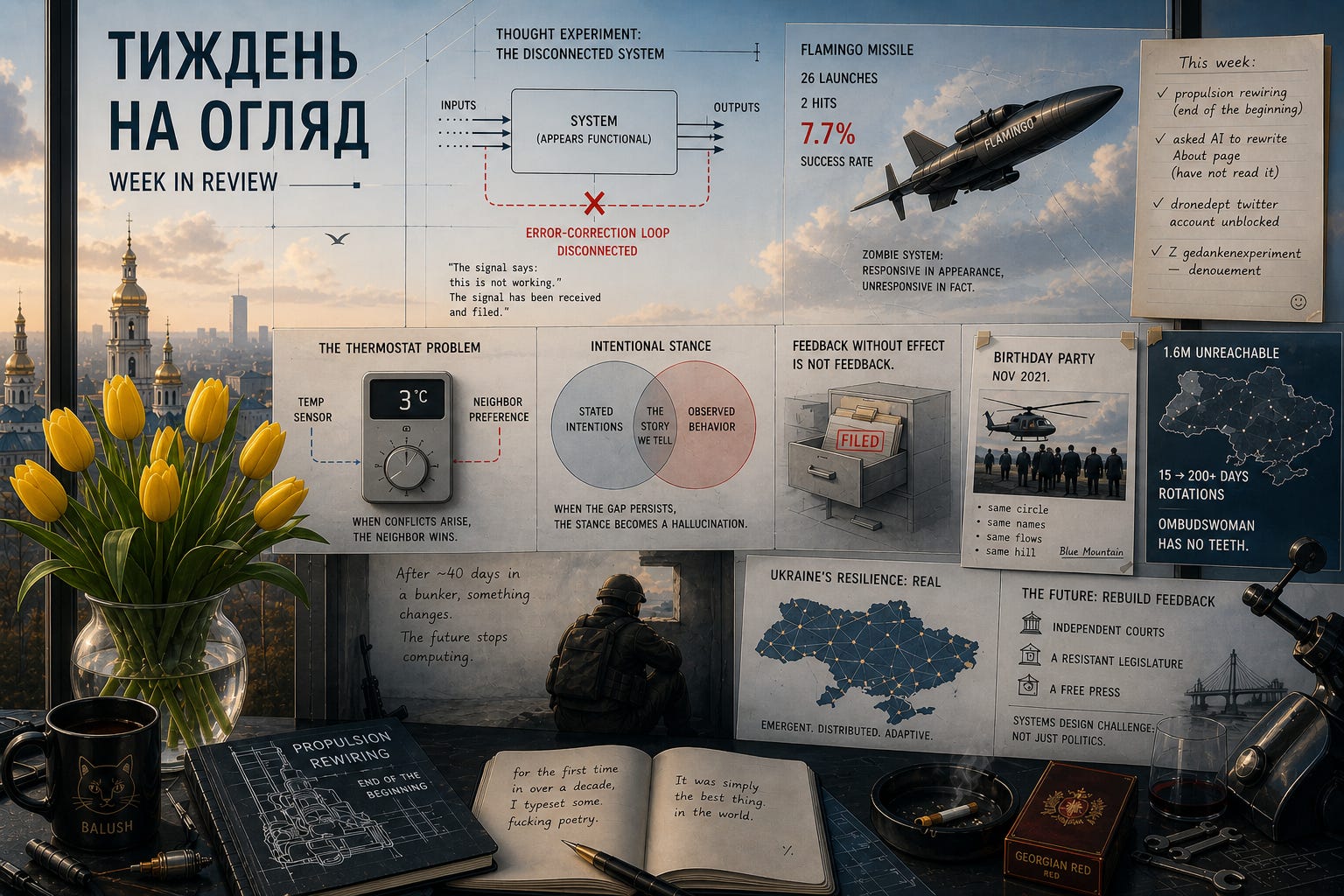
Friday. Unshaven. Marginally operational.
This week:
– continued rewiring of the propulsion system (end of the beginning, I think)
– asked AI to rewrite my About page (have not read it, already suspicious)
– dronedept Twitter account mysteriously unblocked
– and the denouement of the Z thought experiment (last four posts)
Logical positivist Rudolph Carnap might boil down our experiment down to this:
Imagine you design a system to turn inputs into outputs efficiently. Naturally, you include feedback loops—ways for the system to notice when it’s failing and correct itself.
Now imagine someone quietly disconnects the inconvenient feedback loops.
The system still runs. It produces outputs. From the outside, everything looks normal.
Only the outputs drift.
This is not a thought experiment.

There is, for instance, a missile called the Flamingo. It has reportedly been used twenty-six times in combat. It has hit its target twice.
That’s a 7.7% success rate.
Pause on that. Not because the number is shocking—it isn’t, statistically—but because it’s informative. It’s a signal. The system, such as it is, is saying: this isn’t working.
The signal has been received and filed somewhere that does not influence procurement. The program continues. Contracts continue. By late 2025, a former CIA director has joined the advisory board.
From the outside: activity, continuity, seriousness.
From the inside: no meaningful adjustment.
Philosophically, this is what you might call a zombie system—responsive in appearance, unresponsive in fact.
(One of the AI About-page lines, I’m told, says I have a habit of mistaking persistence for functionality. That seems… relevant.)
The intentional stance problem, institutional edition
When you look at a chess engine, you can describe it three ways: as hardware, as code, or as something that “wants” to control the center.
That last one—the intentional stance—is a shortcut. We use it on institutions all the time. The Defense Ministry wants to defend the country. Courts want to deliver justice.
Usually, that shorthand works.
It stops working when it becomes a kind of polite hallucination—when behavior consistently contradicts the supposed goal, and we keep the story anyway because updating it would be inconvenient.
So: what does the Ukrainian Defense Ministry actually want?
Not what it says. What does it do?
Leaked transcripts help. When a defense minister responds “it stands today” to a private individual’s procurement instruction, we’re no longer in the realm of intentions. We’re looking at mechanism.
And the mechanism is not arranged the way the story says it is.
The thermostat problem
A thermostat is honest. Too cold: heat on. Too hot: heat off. Feedback loop intact.
Now give your neighbor partial control. Sometimes their preference overrides the temperature reading.
You no longer have a thermostat. You have something else wearing a thermostat costume.
Current data points:
– 1.6 million mobilization-eligible citizens unreachable
– legally mandated 15-day rotations stretching into 200–300 days
– an ombudswoman documenting all this without the authority to enforce change
That’s not a flawed system. It’s a different system—one optimized for the appearance of responsiveness.
Daniel Kahneman would recognize it instantly: fast, intuitive, persuasive—and largely indifferent to correction.
The birthday party
The most interesting datapoint this week isn’t technical. It’s social.
November 2021: a private celebration at a state residence, reached by state helicopter. A small circle of men. The same names later show up in procurement flows, transcripts, adjacent real estate (Blue Mountain). The President is addressed by a nickname.
None of this is illegal, or even unusual. People have friends.
What matters is memetics—not conspiracy, but replication. Shared assumptions, habits, intuitions about how things work. Reinforced over dinners, favors, proximity. Over time, this becomes the operating system.
Operating systems are hard to dislodge. You don’t notice them until things start crashing.
(The AI About page, allegedly, describes me as “someone who lingers at the level below narrative, where systems quietly decide what stories are allowed to be true.” I wish I’d written that. I probably didn’t.)
Two systems, running in parallel
Ukraine’s military resilience is real. It’s emergent, distributed, adaptive—what you get when selection pressure does the design work.
The political infrastructure is something else. Parallel, not fully integrated, occasionally cooperative.
This is normal, biologically speaking. Systems coexist. They align when forced.
But clarity matters: the heroic narrative merges them. Reality doesn’t.
Which leads to reconstruction.
Rebuilding courts, a legislature, a functioning press—these aren’t “political reforms.” They’re system redesign.
And the first rule of redesign is simple: you don’t fix a system using only the parts that broke it.
The Blue Mountain circle will not dismantle Blue Mountain. Not because they’re bad people. Because that’s not how systems behave.
The soldiers
There’s a threshold, the ombudswoman suggests: around forty days.
After that, something shifts. Not cowardice—optimization. The brain stops modeling the future because the future no longer reliably exists.
This is what prolonged stress without feedback does to a system.
These are the people the Flamingo was meant to help.
7.7% is the answer they’re getting.
If we’re being honest—and clarity, not comfort, is the whole point here—that answer isn’t just immoral.
It’s diagnostic.
It tells you the system is failing.
And unlike moral failures, system failures are fixable.
But only if you stop calling the system “functional” just because it’s dramatic.
Song of the Week:
Have a great weekend!